Best Solar Microgrids United States: The Definitive Guide
The structural integrity, transmission reliability, and environmental sustainability of domestic power infrastructure have experienced profound transformations. Because of this, best solar microgrids united states has become a critical benchmark for regional utility operators, municipal planners, and industrial facility directors. Traditional centralized electrical grids face compounding pressures. Specifically, long-distance transmission vulnerability, aging substation transformers, and high carbon intensity drive these challenges. Climate volatility and extreme weather disruptions worsen them. Therefore, forward-thinking energy engineers are turning toward distributed photovoltaic power systems. These installations center on solar generation arrays and commercial battery energy storage systems. Furthermore, automated master controllers enable local distribution loops to achieve seamless islanding.
Evaluating the structural viability of these advanced clean energy networks requires moving beyond standard marketing glossies. This inquiry demands an unvarnished look at how utility-scale photovoltaic integration converges with intelligent switchgear and multi-day battery storage vaults. As a result, they alter the fundamental reliability economics of electricity distribution.
Understanding “best solar microgrids united states”
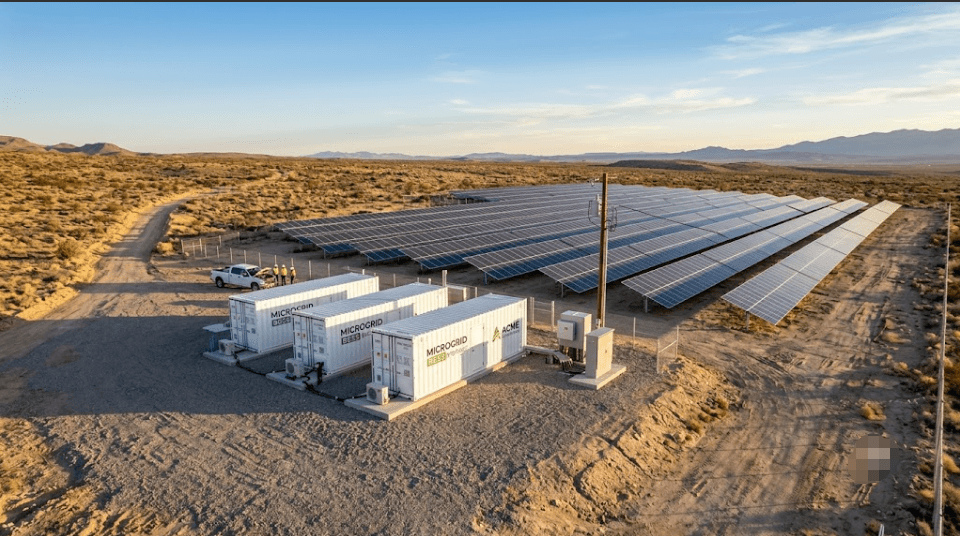
Assessing the criteria that define top-tier decentralized power networks reveals a wide gap between marketing claims and actual engineering. The category of best solar microgrids united states is frequently sensationalized by commercial equipment vendors. For instance, they use it to describe standard rooftop solar arrays paired with basic backup generators. However, true environmental integrity and long-term grid resilience require a much deeper standard of evaluation.
A common misconception is that any localized solar array featuring a rudimentary inverter qualifies as a resilient microgrid. In reality, standard grid-tied solar systems automatically shut down during regional blackouts. This shutdown occurs due to strict anti-islanding safety requirements designed to protect utility line workers. True leadership-class solar microgrids integrate automated static transfer switches. Furthermore, they use sophisticated microgrid control software and multi-hour battery storage banks. Thus, they can decouple safely from the central transmission grid while maintaining continuous power.
Oversimplification risks also plague how energy analysts judge these systems. Counting total peak solar generation capacity ignores storage duration metrics. A microgrid can feature vast photovoltaic acreage. However, if its control system lacks dynamic frequency regulation, the local network will experience voltage collapse during an emergency. Consequently, top-tier microgrids rely on simultaneous optimization: balancing instantaneous generation with responsive storage.
Deep Contextual Background
The evolution of modern decentralized solar infrastructure emerged from decades of dropping photovoltaic hardware costs. At the same time, lithium-ion battery chemistry advanced, and municipal regulatory frameworks shifted. Early iterations of solar microgrids in the late twentieth century typically manifested as isolated remote power systems. These early projects prioritized basic electrification over software-driven grid interoperability. Consequently, these pioneering developments remained expensive curiosities rather than scalable models.
By the early 2010s, smart inverter software and modular battery storage revolutionized distributed energy resource management. Progressive states like California, New York, and Hawaii began partnering with technology providers. Together, they designed complex socio-technical systems that could support critical facilities during outages. Specialized electrical engineering firms emerged to bridge the gap between volatile solar generation and steady baseload demand.
The turning point arrived when intelligent microgrid management platforms emerged. These platforms could seamlessly balance real-time solar harvesting, battery state-of-charge, and automated load-shedding protocols. This systemic shift allowed forward-thinking institutions to achieve continuous operational continuity during regional storms. Furthermore, they accomplished this while participating actively in local wholesale energy markets.
Conceptual Frameworks and Mental Models
Analyzing how modern solar microgrids operate requires structured mental models. These mental models strip away marketing rhetoric to expose underlying engineering realities.
-
The Islanding Transition Latency Index: This framework evaluates a microgrid’s speed in disconnecting from the main utility feed during a grid collapse.
-
The Solar-to-Storage Capacity Ratio: This model measures whether a microgrid possesses sufficient battery capacity to absorb peak midday solar generation without overloading local transformers.
-
The Critical Load Priority Matrix: This evaluates whether an energy network can dynamically shed non-essential loads to preserve runtime for life-safety infrastructure.
-
The Dispatchable Renewable Autonomy Vector: This structural model assesses how many consecutive days an installation can sustain operations solely on solar inputs without fossil-fuel backup.
Key Categories or Variations
Solar microgrids across the United States fall into distinct structural categories. Each category faces unique geographic challenges and operational trade-offs.
-
Critical Municipal Infrastructure Microgrids: City-owned energy networks powering police stations and water treatment facilities during natural disasters.
-
Military Base Energy Resilience Hubs: Secure microgrids combining solar arrays, wind turbines, and backup generation to guarantee defense readiness.
-
Commercial Campus Microgrids: Private manufacturing campuses utilizing large solar canopies and battery vaults to optimize demand charges.
-
Island and Remote Community Microgrids: Isolated enclaves substituting expensive imported diesel generation with solar-plus-storage autonomy.
-
Community-Scale Residential Microgrids: Suburban housing developments sharing localized solar generation and community battery storage.
-
Higher Education Research Microgrids: University campus energy networks serving as living laboratories for smart grid testing.
Structural Comparison of Solar Microgrid Models
| Microgrid Category | Primary Generation Profile | Storage & Control Architecture | Primary Vulnerability | Resilience Tier |
| Critical Municipal Networks | Rooftop & Carport Solar PV | Lithium-ion BESS + SCADA Control | Cyber Threats / Maintenance Budgets | High |
| Military Resilience Hubs | Ground-Mount Solar + Wind | Hardened BESS + Physical Security | Kinetic Attacks / Complex Logistics | Maximum |
| C&I Campus Systems | Massive Rooftop & Ground Solar | Industrial BESS + Peak Shaving | Load Surges / Tariff Changes | Moderate-High |
| Remote Island Enclaves | Hybrid Solar-Diesel Arrays | Modular BESS + Automated Droop | Salt Corrosion / Logistics Isolation | High |
| Community Residential | Distributed BIPV + Central Solar | Community Vault + Smart Meters | Governance Disputes / Shading | Moderate |
Choosing among these systems requires balancing capital expenditure against regional climate threats. Municipal hubs demand maximum hardening against disruptions, whereas commercial microgrids focus heavily on economic optimization.
Detailed Real-World Scenarios
To understand how these theoretical frameworks manifest in practice, consider several distinct operational scenarios.
Scenario A: Severe Ice Storms and Regional Transmission Collapse
During a massive winter ice storm, transmission lines fail across multiple counties. A municipal critical infrastructure microgrid detects a frequency drop and trips its static transfer switch. The facility isolates its internal loop, utilizing solar generation and battery storage to keep emergency dispatch running. However, a second-order effect emerges regarding ice accumulation on solar panels. Frozen precipitation blocks light absorption, requiring automated heating elements or manual clearing teams to restore generation.
Scenario B: Summer Heatwave Peak Demand and Tariff Optimization
At a commercial manufacturing campus in the Southwest, a summer heatwave drives air conditioning loads to record highs, triggering high utility demand charges. The campus microgrid’s control software shifts facility operations to stored solar energy harvested earlier, avoiding expensive grid penalties. A failure mode occurs if cloud cover rolls in during mid-afternoon. Consequently, the control algorithm must modulate non-essential motor loads to prevent deep battery depletion.
Scenario C: Coastal Hurricane Impact and Salt-Air Degradation
A coastal military base energy hub faces an incoming hurricane that pushes severe storm surge onshore. The microgrid’s elevated switchgear and waterproof enclosures protect core electronics from short circuits. While surrounding towns suffer prolonged outages, the base microgrid maintains complete operational readiness. Nevertheless, wind-driven salt spray coats photovoltaic glass, degrading efficiency until washing crews service the array.
Planning, Cost, and Resource Dynamics
The economic architecture of deploying top-tier solar microgrids involves complex interactions between capital intensity, tax incentives, and ongoing resource management.
Upfront investments in commercial microgrid infrastructure exceed standard grid-tied solar installations. Facility owners must absorb capital expenditures associated with engineering microgrid controllers, purchasing battery storage vaults, and upgrading switchgear. These costs are offset over time through federal Investment Tax Credits, avoided outage losses, and peak demand charge reductions.
However, evaluating these figures purely through initial construction budgets creates an incomplete picture. The ongoing operational burden requires specialized engineering oversight. Unlike conventional grid-connected facilities, microgrids demand active asset management teams to monitor control software and service inverter hardware.
Financial and Operational Resource Metrics
| Cost & Resource Vector | Standard Grid-Tied Solar | Advanced Solar Microgrid System |
| Initial Engineering & Hardware Outlay | Standard Inverter & Panels | $+40\%$ to $+100\%$ Premium for BESS & Controllers |
| Monthly Utility Interaction | Standard Net Metering / Bill | Dynamic Peak Shaving / Demand Response Revenue |
| Maintenance Burden | Basic Panel Washing | Specialized Microgrid Software & Battery Servicing |
| Outage Risk Exposure | High Vulnerability to Grid Drops | Zero Disruption via Autonomous Islanding |
| Asset Lifespan & Replacement | 25-Year Panel Warranty | Staggered BESS Augmentation Every 10–15 Years |
Tools, Strategies, and Support Systems
Maintaining optimal performance across a complex solar microgrid requires sophisticated software, telemetry, and hardware support systems.
-
Supervisory Control and Data Acquisition (SCADA): Industrial platforms that monitor real-time power generation and battery state-of-charge.
-
Advanced Microgrid Controllers (AMCs): Computing hardware that executes automated islanding and economic dispatch algorithms.
-
Static Transfer Switches (STS): Electronic switches that disconnect the microgrid from the main utility within milliseconds during faults.
-
Thermographic Drone Inspection Fleets: Aerial thermal imaging used to identify failing photovoltaic bypass diodes or resistance hotspots.
-
Battery Management Systems (BMS) Telemetry: Firmware that regulates cell-level charging parameters to maximize storage lifespan.
-
Predictive Solar Forecasting Software: Meteorological tools that analyze cloud cover dynamics to forecast hourly generation curves.
-
Remote Telemetry Diagnostics: Secure linkups allowing off-site engineering firms to diagnose microgrid faults before dispatching technicians.
Risk Landscape and Failure Modes
Every complex electrical system harbors inherent vulnerabilities. A clear-eyed evaluation of solar microgrids requires categorizing compounding risks.
-
Central Controller Software Glitches: If a primary supervisory controller experiences a software failure without a redundant unit, the microgrid can lose its islanding capability.
-
Battery Thermal Runaway Events: High-density lithium-ion storage enclosures carry thermal risks if cell-level monitoring fails, requiring advanced suppression systems.
-
Cybersecurity Vulnerabilities: Internet-connected microgrid controllers and smart meters introduce potential vectors for digital intrusion and grid disruption.
-
Supply Chain Bottlenecks: High-voltage static switches and custom switchgear can experience long procurement lead times during global supply disruptions.
-
Physical Security Breaches: Remote ground-mount solar fields and battery vaults are vulnerable to copper theft and physical tampering.
Governance, Maintenance, and Long-Term Adaptation
The long-term viability of a solar microgrid depends heavily on rigorous governance schedules. When initial construction concludes, management teams must establish strict oversight routines to prevent electrical degradation.
Effective management models incorporate multi-year asset reserve studies earmarked for infrastructure renewal, such as battery augmentations and inverter replacements. Furthermore, comprehensive logging ensures that protective relay testing and battery health metrics are continuously evaluated.
Layered Maintenance and Review Checklist
-
[ ] Monthly: Review microgrid generation logs, battery efficiency metrics, and transfer switch testing.
-
[ ] Quarterly: Inspect ground-mount solar arrays, electrical enclosures, and accessible conduit runs visually.
-
[ ] Semi-Annually: Audit software firmware for microgrid controllers, smart meters, and load-shedding platforms.
-
[ ] Annually: Perform electrical testing of rapid shutdown mechanisms, grounding rods, and protective relay calibration.
-
[ ] Triennially: Review capital reserve funds to ensure financial pooling aligns with battery augmentation timelines.
Measurement, Tracking, and Evaluation
Assessing whether a solar microgrid is fulfilling its operational promise requires tracking a precise balance of technical indicators.
-
Leading Indicators: Metrics that predict future reliability, such as battery cell temperature stability and inverter efficiency trends.
-
Lagging Indicators: Historical performance markers, including annual grid power import ratios and unplanned outage duration metrics.
-
Quantitative Signals: Megawatt-hours generated versus consumed locally and peak demand reduction percentages.
-
Qualitative Signals: Operator confidence, emergency response readiness perception, and regulatory compliance satisfaction.
Documentation and Verification Examples
-
Microgrid Performance Audit Reports: Automated data records tracking voltage stability and seamless islanding transitions during tests.
-
Battery Health and Capacity Logs: Engineering documentation verifying state-of-health degradation rates across storage racks.
-
Regulatory Interconnection Compliance Filings: Formal documentation confirming that the microgrid meets IEEE 1547 safety standards.
Common Misconceptions and Oversimplifications
Dissecting the topic of advanced solar microgrids requires dismantling persistent myths that cloud public understanding.
-
Myth 1: Any solar installation with a battery backup functions as a true microgrid. Correction: True microgrids feature sophisticated control software and static transfer switches capable of islanding an entire local distribution network.
-
Myth 2: Solar microgrids eliminate the need for ongoing professional maintenance. Correction: Complex electrical inverters, battery storage vaults, and protective relay systems demand active monitoring and periodic servicing.
-
Myth 3: Battery storage systems make solar microgrids entirely independent of weather patterns. Correction: Extended periods of heavy cloud cover will eventually deplete storage reserves, necessitating careful load management.
-
Myth 4: Microgrid installation requires no coordination with local electric utilities. Correction: Designing and interconnecting a microgrid requires extensive utility collaboration, impact studies, and strict safety adherence.
-
Myth 5: Lithium-ion battery installations pose an unmanageable community fire hazard. Correction: Modern commercial storage installations utilize advanced thermal management, aerosol suppression, and strict UL 9540 safety certifications.
-
Myth 6: Microgrids are economically unviable without permanent government subsidies. Correction: While tax credits accelerate adoption, escalating utility demand charges make microgrids increasingly attractive on pure economic fundamentals.
Ethical, Practical, and Contextual Considerations
Developing extensive solar microgrids introduces significant ethical and socioeconomic questions. Large-scale implementations can inadvertently create an energy divide, wherein wealthy corporate campuses secure absolute power resilience while surrounding communities remain tethered to vulnerable transmission infrastructure. Responsible planning requires integrating equitable community benefit agreements, ensuring fair access to backup power during emergencies, and engaging local stakeholders in transparent siting dialogues. Furthermore, respecting regional indigenous heritage and preserving local watershed integrity during ground-mount solar construction is essential for long-term harmonious co-existence.
Conclusion
The evolution of best solar microgrids united states represents a fundamental maturation in how human settlements and industrial enterprises approach resource security and grid resilience. Designing, constructing, and maintaining microgrids capable of sustaining high energy autonomy requires deep alignment between electrical engineering, advanced battery storage, financial rigor, and long-term facility governance.
While challenges remain regarding upfront capital intensity and regulatory hurdles, these advanced decentralized energy networks offer a resilient blueprint for the future. Success ultimately relies not on superficial marketing narratives, but on patient adherence to engineering fundamentals, multi-tiered infrastructure redundancy, and adaptive management over decades of continuous operation.